


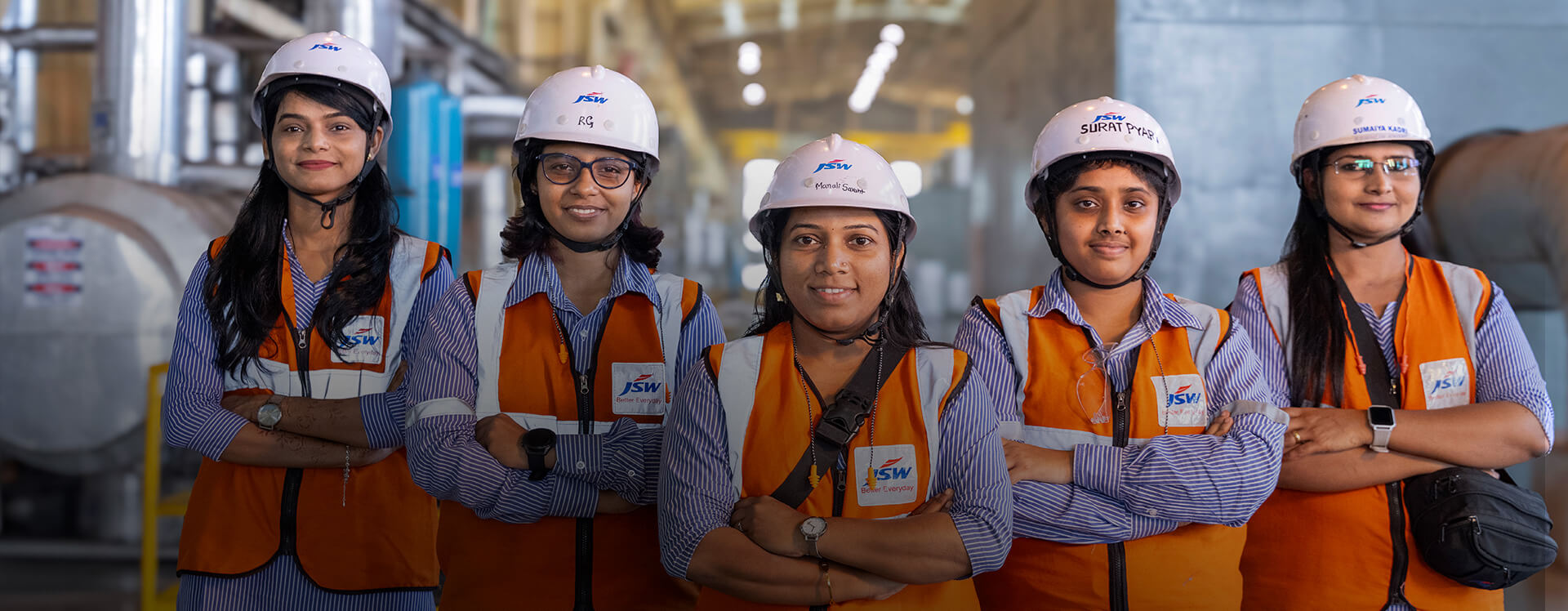
Human capital is the backbone of any industry. In an organization with the provision of good working conditions, employees are highly likely to be more positive, more motivated, and therefore more productive. Other benefits include higher employee retention rates, reduced instances of employee unrest, and fewer grievance claims. JSW has taken various efforts and initiatives to promote a healthy and safe work environment for all its employees through a focus on the prevention of occupational accidents and diseases.
Occupational Health and Safety is a material topic for us at JSW, and the safety of its employees is fundamental to the reputation and performance of our Company. Highest priority is accorded to the principle of prevention.
Our OHS management system is based on the ISO 45001:2018 system. These systems ensure that work-related injuries and ill health are reported timely and investigated for root causes. Construction feedback is sought from employees regularly to understand gaps in health and mental wellbeing initiatives.
Health and safety criteria form a part of our contracts with all suppliers. Before onboarding, a PQA (Prequalification Assessment) is conducted; only vendors scoring more than 50% are eligible to enter a contract with JSW Energy.
We have established an emergency response plan at the plant level as a Standard Operating Procedure (SOP) for situations such as fire, earthquakes, or floods. Mock drills are conducted for critical activities.
All four major power plants identified high-risk scenarios (numbered 20 to 25) which were mitigated through our BHM (Barrier Health Management) tool. This tool added safety controls to bring down the Risk Rating to below 5 (minimal risk). We have set a target to achieve an LTIFR across JSW Energy below 0.29 for FY 2025-26.
The Major Safety Systems being used at JSW Energy include:
We hired 904 employees in the reporting period. During this time, the total turnover rate stood at 10.46%, and 100% of the employee turnover was voluntary.
| Internal Hires | FY 2022-23 | FY 2023-24 | FY 2024-25 |
|---|---|---|---|
| Count | 145 | 215 | 234 |
| Average Hiring Cost/FTE (INR) | FY 2021-22 | FY 2022-23 | FY 2023-24 | FY 2024-25 |
|---|---|---|---|---|
| Cost | 1,11,772.57 | 93,078.10 | 39,514.31 | 72,722.27 |
We reward our employees through two ESOP schemes: JSWEL Employees Stock Ownership Plan - Samruddhi 2021 and JSWEL Employees Stock Ownership Plan - 2021. These cover 100% of our employees. Eligibility is tied to KRAs, which include sustainability components like safety performance and plant-specific parameters like energy and water consumption.
We provide flexible working hours ("flexi time"), requiring core attendance while allowing start times 1.5 hours before or after the standard time. We also introduced "short leave" allowing 4 hours of leave per month. Parental benefits include 26 weeks of maternity leave and one week of paternity leave, applicable to adoption, surrogacy, and fostering. Creche facilities and lactation rooms are available at all plant locations.
| Employee Satisfaction Score | FY 2021-22 | FY 2022-23 | FY 2023-24 | FY 2024-25 |
|---|---|---|---|---|
| Score | 74% | 74% | 86% | 82% |
Our performance management uses a comprehensive appraisal process based on Key Result Areas (KRA). This includes Performance Planning at the start of the year, Mid-year Reviews, and a Year-end Assessment followed by a Calibration process. Agile conversations between managers and employees occur throughout the year.
We utilize a multi-dimensional appraisal system for selected levels and a recognition portal named "Spotlight". Safety standards are linked to team goals; if zero-fatality targets are not met at a site, all employees at that site are assessed as a team, impacting variable pay.
We provided an average of 29 hours of training per employee and spent INR 14,381 per employee on development in FY 2024-25.
| Average Training Hours (FY 2024-25) | Male | Female |
|---|---|---|
| Senior Management | 16.6 | 13.2 |
| Middle Management | 33.9 | 24.6 |
| Junior Management | 39.39 | 70.9 |
| Non-Management Level | 13.4 | 19.7 |
Coaching interventions at JSW Energy empower leaders and build a future-ready workforce. This includes executive coaching with certified external coaches for senior leaders and managerial coaching for mid-level leaders. We also foster community through the Diversity and Inclusion (D&I) Council and the Women Network.
| Training Programs | Description |
|---|---|
| Senior Leadership Development Program | Bespoke journey with Brown University to sharpen strategic thinking. |
| Energy Leaders for Tomorrow | Identifies high-potential talent; assessed 603 employees in middle and junior management. |
| Crucial Conversation | Equips line managers with skills to provide constructive feedback; increased engagement by 14%. |
| Pre-Retirement Workshop | "Pillars of Success Post Retirement" provided practical strategies for 34 participants. |
| Digital Transition Programs | Includes "Digivolve" for Industry 5.0 skills and Digital Induction for new joiners. |
| Boiler Modification Program | Enhanced knowledge for boiler performance; led to cost savings of approximately INR 374 crores. |
| Global Wind Organisation Training | Specialized safety training for 160 contractual workers received GWO certification. |


